

Kuiper Belts aROUND DISTANT sTARS
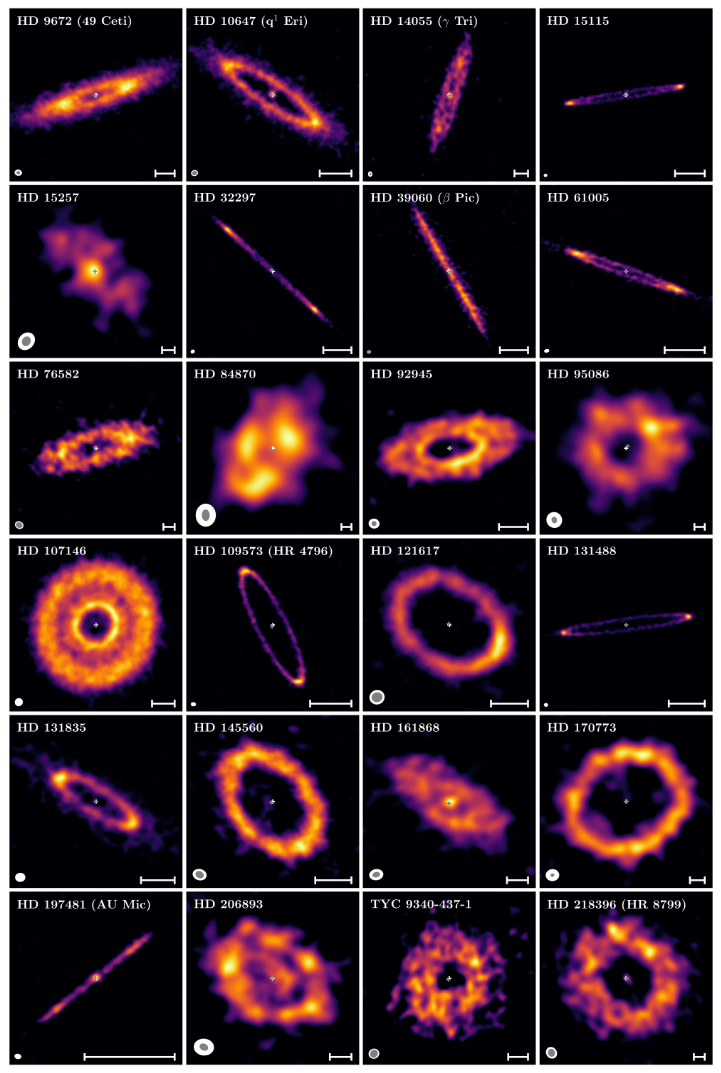
Beyond the orbit of Neptune lies the Kuiper Belt, a torus of (likely) millions of icy boulders orbiting the Sun at mostly between 30 and 50 times the Earth-Sun distance. These icy boulders, of which Pluto may be the largest, are considered to be leftover material from the formation of the Solar System. The Sun is not unique in this respect, and other stars have been spotted to have their own remnant belts or disks of icy boulders, dust and sometimes even gas. In today's news, a selection of 24 of these so-called "exoKuiper Belts" has been imaged beautifully by the Atacama Large Millimetre Array, producing the crispest sample of such "debris disks" yet produced by the observatory. The images are the result of an international Large Program called The ALMA survey to Resolve exoKuiper belt Substructures, or ARKS for short, and the team membership includes dao astronomer Brenda Matthews
Attached is the portrait gallery of all 24 debris disks released by the ARKS team. The targets are all disks around intermediate to low-mass stars between 30 and 400 lightyears from the Sun. In the images, you can’t see the stars themselves as their emission at submillimetre wavelengths can be weak, and I believe the team carefully removed any possible contribution by any stellar light from the data to make the images as clean as possible. Each ring or belt is largely circular but seen inclined from our perspective, leading to a foreshortened or even edge-on appearance. Shown in orange is the soft submillimetre wavelength glow from millions of dusty icy boulders combined that surround each star at considerable distances. Indeed, these 24 systems could be likened as “teenage” stars, not too young but not too mature either, and these belts may indicate a phase after planets have formed interior to them where the remaining material is grinding down via collisions into finer dust that is later blown out of these systems. (Also not seen are the invariably cringy posters on these teenagers’ bedroom walls.)
Indeed these debris disks, when looked at in such fine detail, have revealed evidence for other goings on in these systems. For example, about one-third of the belts show substructures, either multiple rings or gaps, that may have been sculpted by as-yet unseen planets in those systems. Further, some disks appear to have locations that appear to be puffed up and asymmetries, possibly because the icy boulders have been stirred by gravitational tugs and scattering by planets. ALMA also detected the faint signals of carbon monoxide gas associated with these systems, which is a big curiosity because such gas should have been removed from these systems long ago. These results, however, are only the tip of the iceberg icy boulder from ARKS, and the team is currently preparing ten papers with each high-lighting an aspect of what they’ve found from their survey in addition to publishing a summary paper. In addition, the team has released all their data to the community for independent analysis and study. For more information on this nice result, here’s a link to the story on phys.org.