
Our Cosmic Origins in the smallest Galaxies
Prof. Kim Venn, University of Victoria
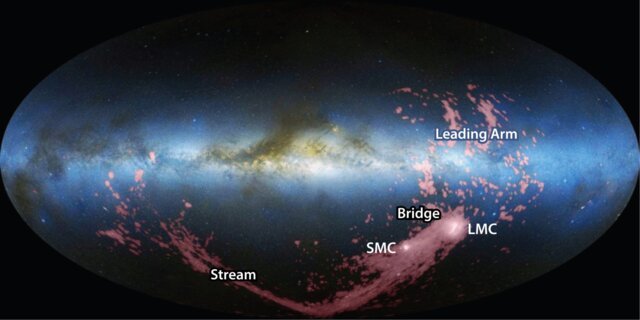
The Magellanic Stream -clues to the formation of our Galaxy
Life, the universe, and (nearly) everything depends on atoms. Most of these atoms formed in stars and supernovae, after the Big Bang. To unravel the complex origins of the chemical elements, we turn to the most pristine systems. These are the tiny satellite galaxies that orbit the Milky Way, which are isolated systems that have experienced much simpler histories of star formation. The GHOST spectrograph, built and tested at NRC Herzberg in Victoria before being delivered to the Gemini South Observatory in Chile, has played a critical role in this research. I will share how UVic researchers are using GHOST to study the chemistry of stars in the nearby dwarf galaxies and what those reveal about the origin of the elements that make up our world.
Bio:

Kim Venn is a professor of Physics & Astronomy at UVic. Her research group uses stellar spectroscopy to answer questions about the oldest stars, the smallest galaxies, and other chemical peculiarities in the universe. She has received numerous honours ranging from awards in research, mentorship, and partnerships, to leadership roles on international observatory advisory and governing boards.