

Vera C. Rubin Observatory Begins Capturing the Greatest Cosmic Movie Ever Made
The month of June ends triumphantly today with the announcement of the official start of the Legacy Survey of Space and Time (LSST). This large project will consist of surveying the entire southern sky repeatedly over the next ten years, using the world's largest digital camera behind the 8-m Simonyi Survey Telescope and the Vera C. Rubin Observatory in which it resides in Chile. The project has been long in coming, and was given a strong endorsement by the US community in its 2010 decadal survey of astronomy priorities. Since then, the project, led by the US National Science Foundation and the US Department of Energy, has opened up the survey to international collaboration, and our Canadian Astronomy Data Centre is participating in it to provide an Independent Data Access Centre of the co-added LSST data products to be released every year. As a result, dozens of Canadian astronomers get to join the larger LSST science team!
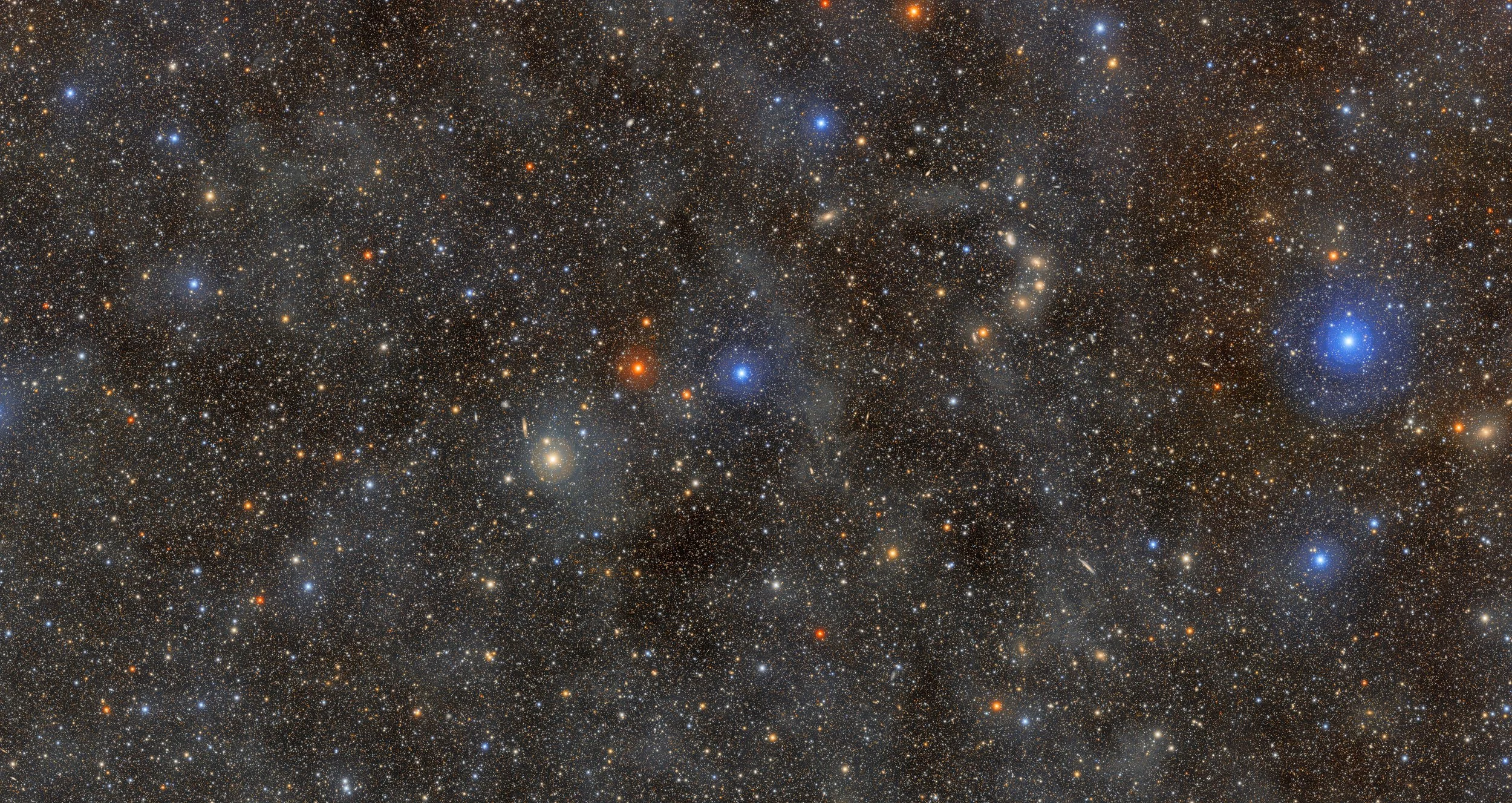
The Ocean of Stars
Some readers may recall the first look images released by the Rubin Observatory team just over one year ago. Today, they have released the attached lovely "Ocean of Stars" image to celebrate the start of the survey. I am not sure why this particular field in southern constellation of Lupus was released but it does contain a whole lot of stars and galaxies. (Perhaps they should have waited just five more days and put out this very “star spangled banner” on July 4? Hmm…) The field is about 190 arcminutes wide and 100 arcminutes high, making it over six full Moon diameters wide and three high, or about 72% the size of the Euclid image I wrote about earlier this week. Perhaps most prominently, you can see the strikingly different colours of stars made apparent by the choices of filters used in the image, here just the optical g, r, and i bands at 480 nm, 622 nm, and 755 nm, respectively. Buried amid all the stars, however, are some very pretty galaxies; the second attached image zooms into about 8 sub-fields highlight some particularly interesting bits.
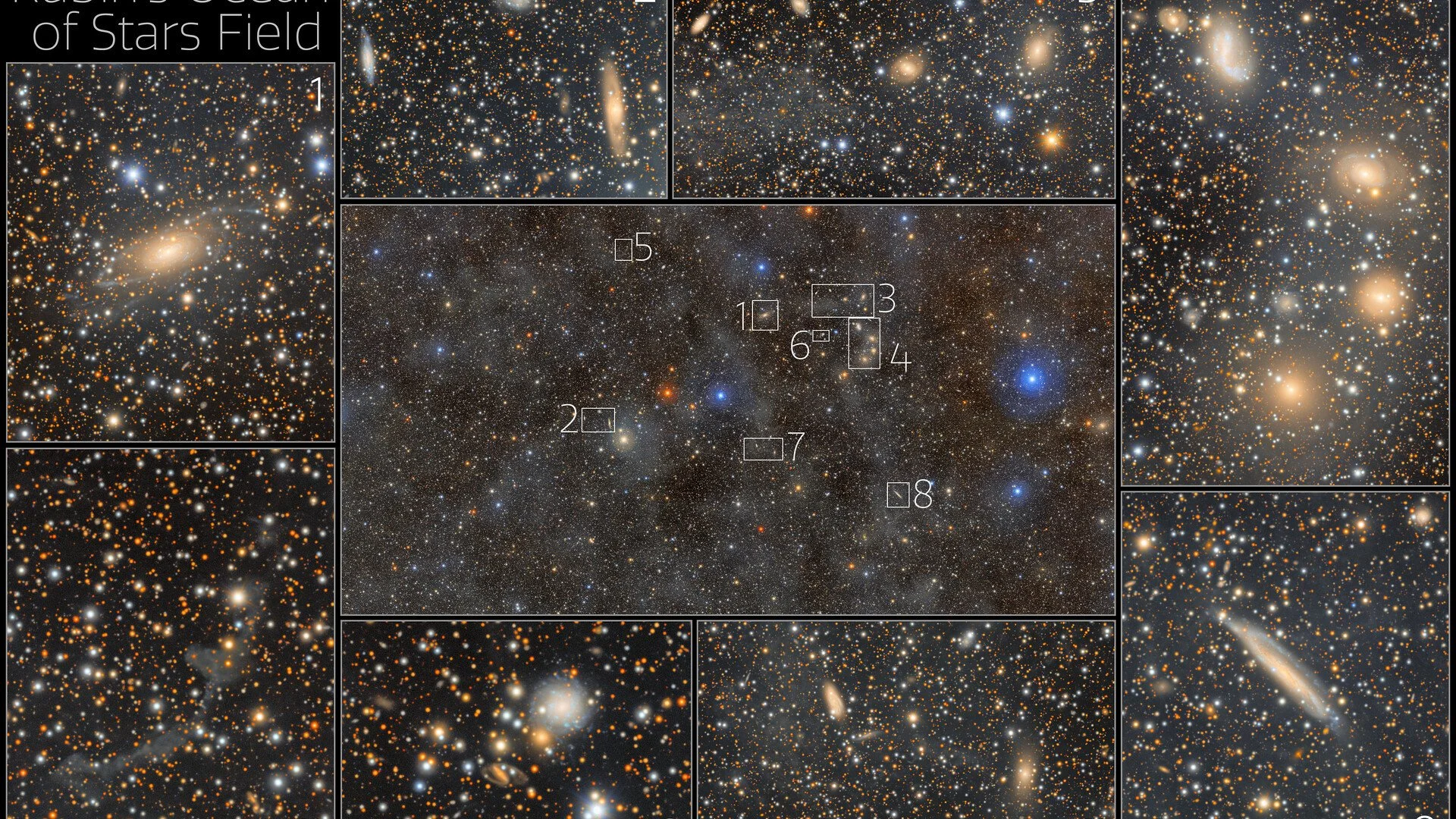
Galaxies in the Ocean of Stars field
Over the course of the survey, LSST will observe this field, and the rest of the southern sky, about 800 times, allowing changes in the brightness and position of astronomical objects to be tracked. The associated press release likens this to a “cinematic” view of the universe, and it’s not wrong since time-lapse movies over a ten-year period will be viewable at the end of the survey. Indeed, every night the LSST is expected to collect 10 terabytes of data and these will be scanned automatically to find anything within them that has changed. About seven million alerts are expected every night and these will be themselves managed by “alert brokers” that will whittle them down to specific scientific cases for plugged-in astronomers to follow given their science interests. On top of that, a co-add of all ten years’ worth of data will produce a very sensitive, huge image of the southern sky, highlighting things that haven’t changed in all that time. For more information, here’s a link to the NOIRLab press release about the survey. It has actually some nice graphics and animations showing how LSST will observe the sky night-after-night so I recommend checking it out!
Thanks to Stephen Gwyn and JJ Kavelaars at NRC for the heads-up about the start of the LSST!
Have a great Tuesday (and Canada Day), everyone!