
The total eclipse experience
Playa Riumar, Delte d’Ebre, Spain 2026 August 12
Picture a crowded beach two hours before sunset. People are in the water splashing, swimming. There are beach volleyball courts set up with plastic rackets strewn around, foam noodles, deck chairs. A boardwalk leading to bars and stores with diving equipment makes the beach narrow at one point, almost cutting it in two. Sand dunes obscure the horizon on one side of this. On the other side, the first notion that this is no ordinary day – a group of people in beach wear standing around a camera pointing toward the western horizon.
Total solar eclipses are magical events not only because of the spectacle in the sky but also because of the effect on the surroundings here on earth – the way the air moves, the quality of the dimming light, and the reaction of the people observing with you.
We chose this spot since the total solar eclipse of 2026 was going to be close to sunset, so it was necessary to be high up or have a flat horizon to the northwest.
This eclipse, which didn’t make much headline in North America in the last few months was a big deal in Western Europe, being the first one since August 1999 visible here (as an aside, I grew up in London, England knowing that the first solar eclipse visible from my native country would be years away in 1999 – by which time I’d long moved to Canada. And it was cloudy, anyway). You may also have seen or heard about the eclipses in the west in August 2017 and in the east in April 2024 – and this one, though shorter in total duration everywhere, didn’t disappoint.
First Diamond Ring
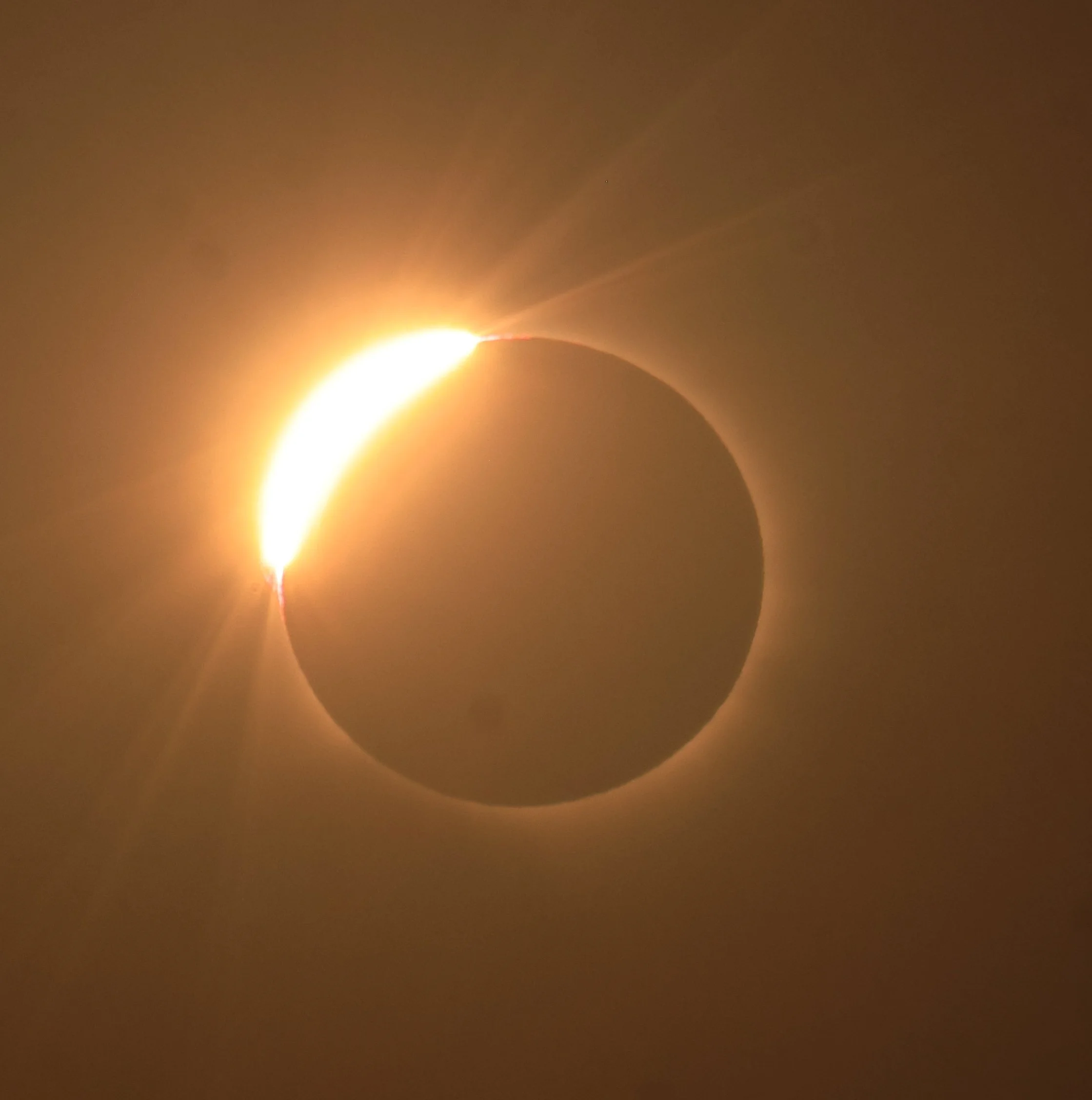
Those of us with cameras with filters and/or eclipse glasses start to notice the bite out of the sun to the lower left (at about the 4 o’clock position), which grows to engulf the sun moving across to the 10 o’clock position. As totality became close, the light started to dim. A slow breeze kicks up as the change in temperature causes a shift in wind direction. By now the crowd is looking intently, the sun shows a ‘diamond ring’ as its last visible limb is all that is left, and then it is gone.
At last… the corona and prominences
Close-up of giant prominence
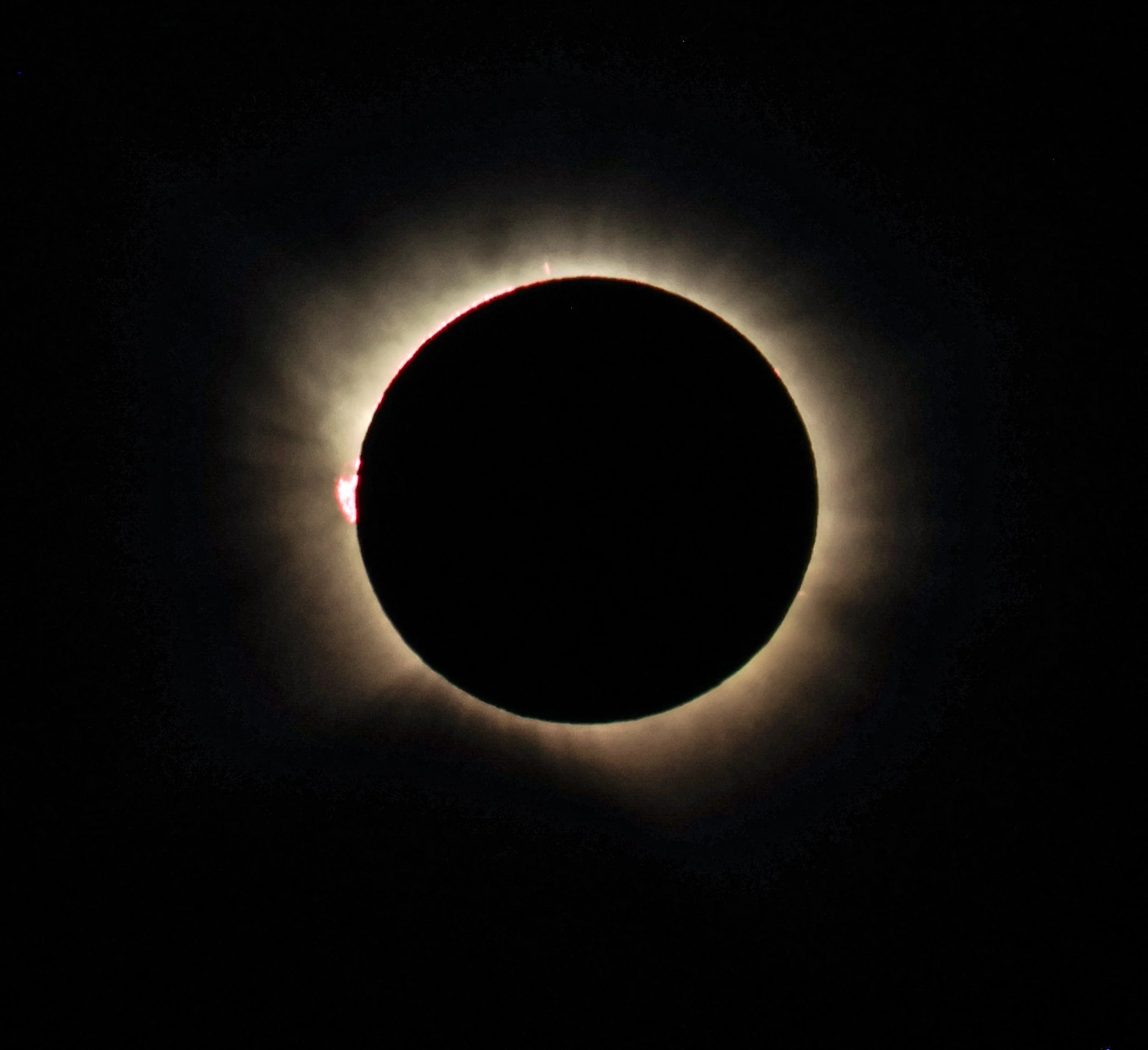
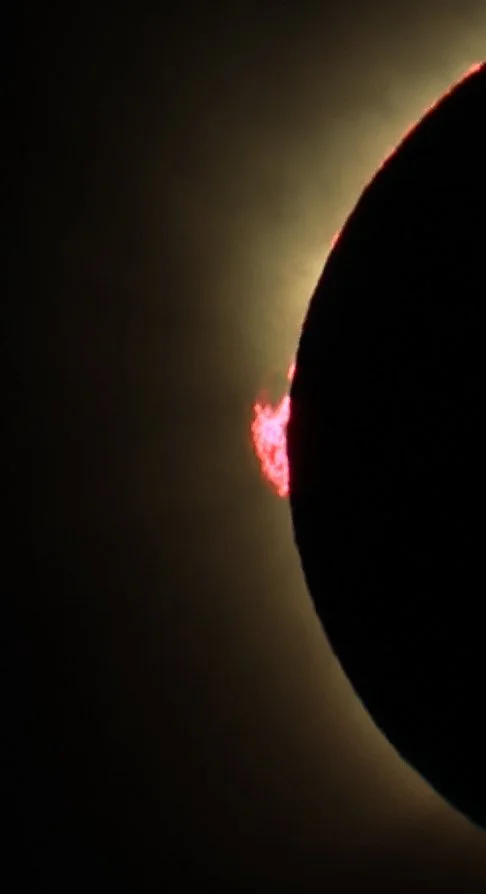
The crowd is wowing, and then cheering, and then silent as they realize what they are seeing. Looking up there’s a black disk with white and red fire surrounding it. Just below where the last rays from the sun were blocked is a huge red prominence, large enough to be visible without magnification. Totality is just 97 seconds from here this time.
For those interested, here is a quick explanation of how eclipses work. For more details, see the NASA site https://eclipse.gsfc.nasa.gov/SEsaros/SEsaros126.html .
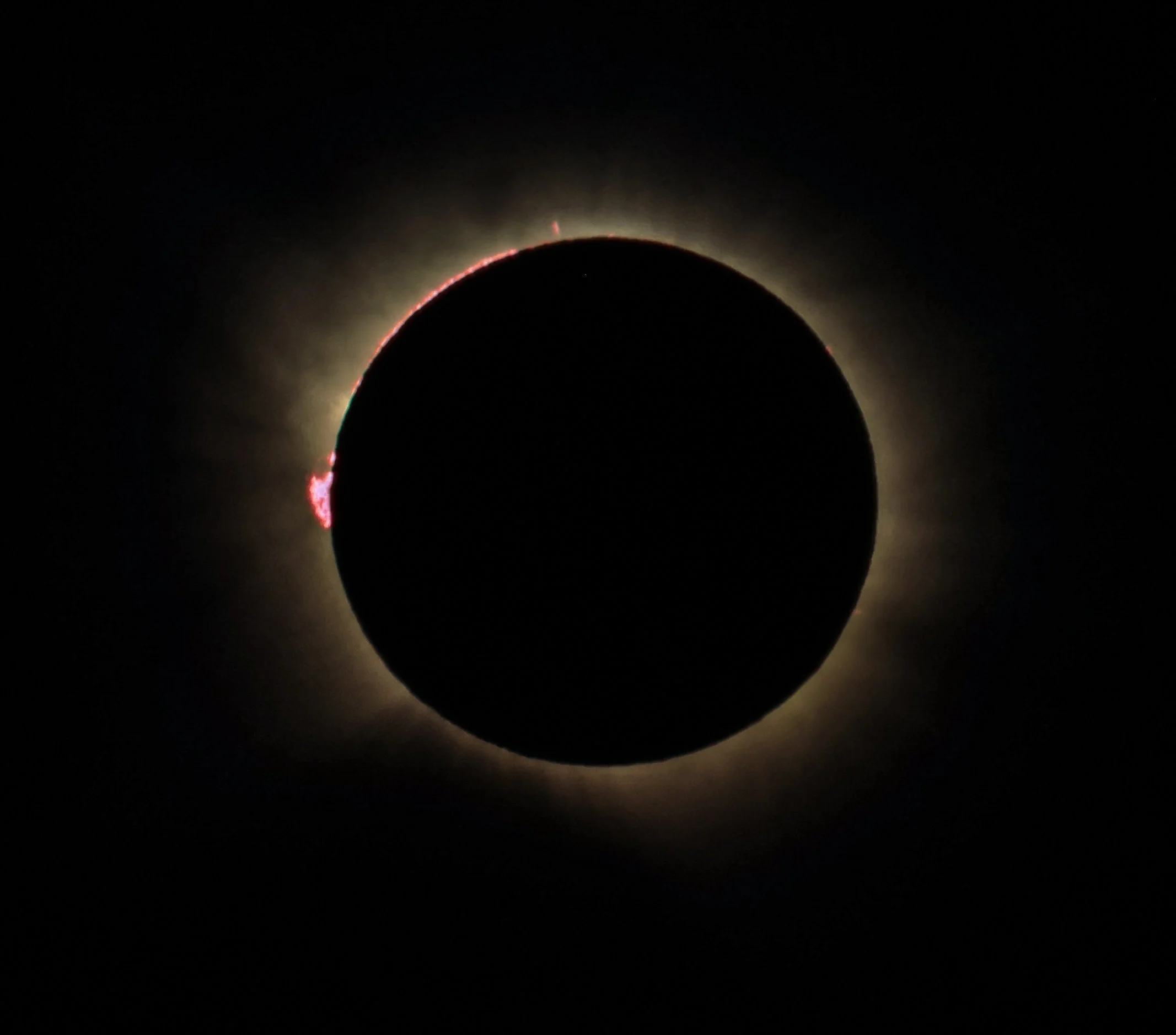
Corona suppressed to show more of the prominences
Eclipses, both solar and lunar, are predicted with great accuracy because of our knowledge of the geometry of the sun earth moon system. Of course the moon passes between the sun and the earth every month, but there is not an eclipse every month. This is because the moon ‘s orbit is inclined to the earth’s orbit – and so most of the time the moon’s shadow (for a solar eclipse) misses the earth. The moon’s orbit must cross the earth’s orbit exactly at New Moon (or Full Moon for a Lunar Eclipse). The passage of the moon across the earth’s orbit is called a node.
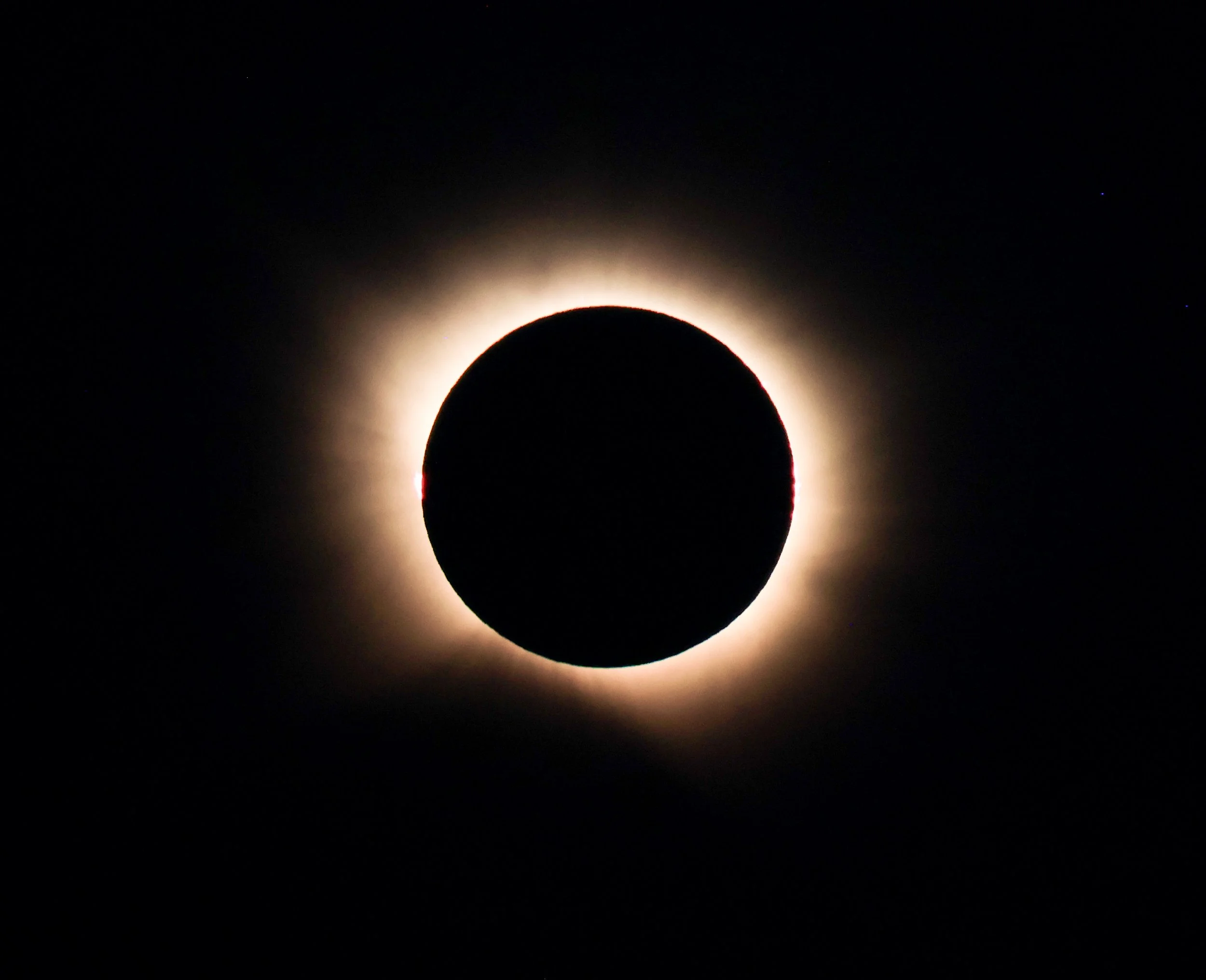
The full corona
Eclipses follow the Saros cycle which is 18 years, 11 days, and 8 hours long (approximately), in which the sun, earth, and moon return to the same relative position. The length of the Saros cycle is given by when the number of moon orbits around the earth is a whole number of node to node cycles.
A Saros series is much longer than one of its cycles. The alignment between the moon’s orbit and its node fails after 1200-1300 years, typically comprising about 70 eclipses. Each of these long series is labelled with a number – this one was 126.
Because of the 8 hours in the Saros cycle duration, eclipses separated by one Saros cycle will occur on the same date, shifted by 120 degrees of longitude. Multiple Saros series run concurrently, so there can be several solar or lunar eclipses in a year belonging to different Saros series.
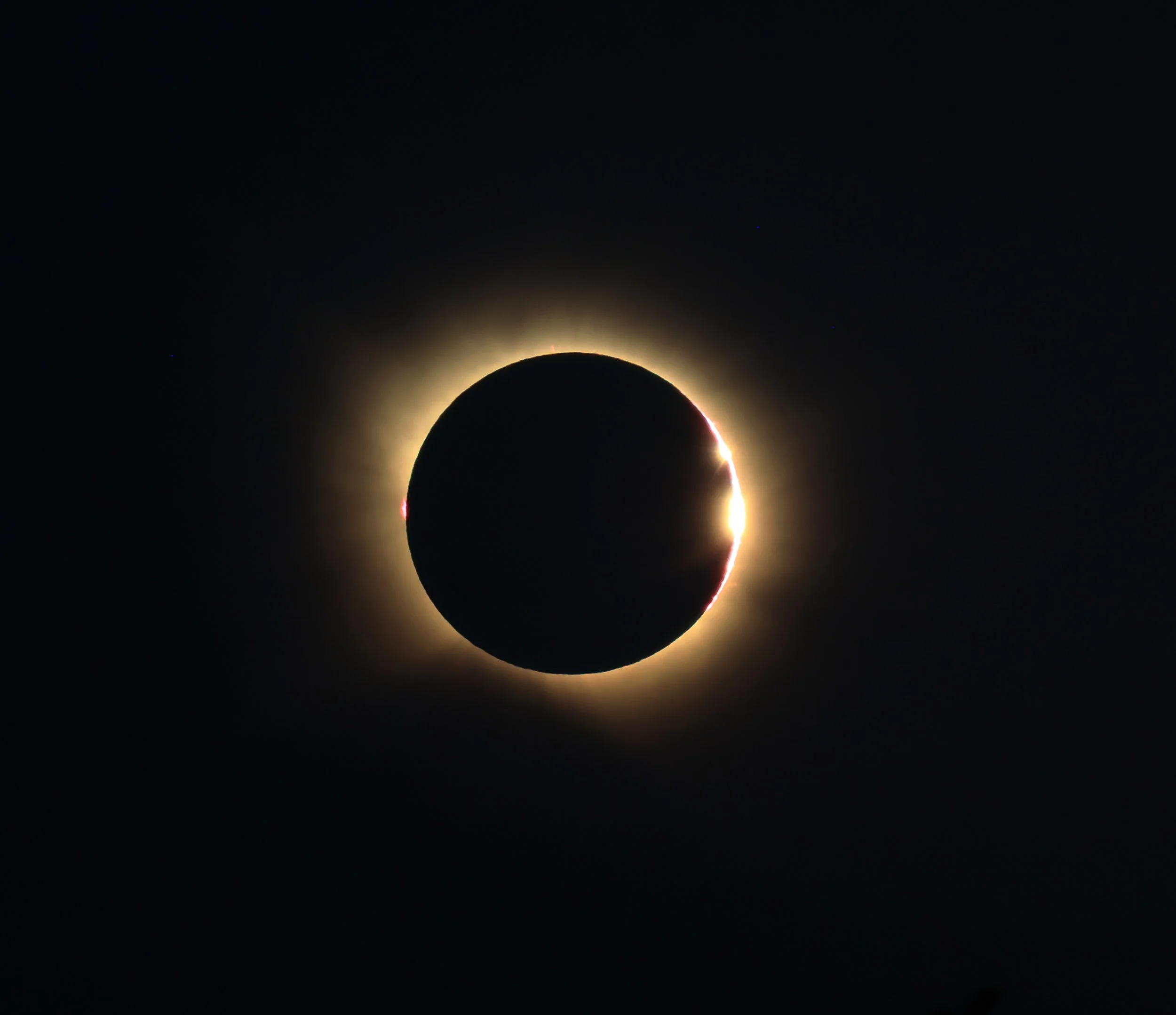
The sun re-emerges
But no understanding of the technicalities of eclipses can take away the magic of the experience, nor can a picture capture it. You just have to be there, and once you’ve seen one, you just have to go again. The next visible from Western Europe will be next year, August 2nd, but it will peak in duration in Egypt, overhead at the Valley of the Kings in Luxor. And the answer is yes – I plan to be there to catch the magic.
